Dear KidsOutAndAbout readers:
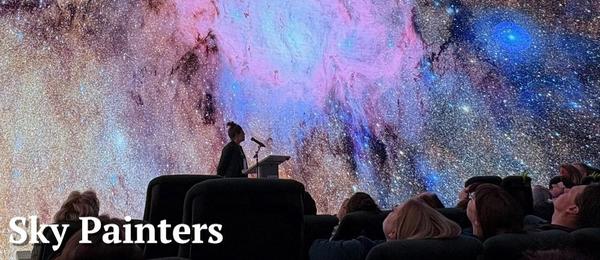
I'm in Phoenix this week for a meeting of the American Astronomical Society, where I'm giving a talk about my new book, The Eclipse Effect. One of the best parts of being here is getting to attend the other presentations, too, which is how I found myself Monday night inside under the Dorrance Planetarium Dome at the Arizona Science Center, gazing up at a sky unlike any I’ve ever seen. Thanks to cutting-edge LED projection technology and the first imagery from the nearly-complete Rubin Observatory in Chile, the dome became a portal into the depths of our galaxy and beyond,
rendered in light so vivid and detailed it felt like we could fall in.
The room was full of astronomers, researchers, educators—professionals who have dedicated their careers to explaining the universe. These were the very people who helped build the tools, who'd worked the math, who’d waited decades to see the science take shape... and even they were astonished: Their faces were lit up with the kind of awe you usually only see in children. It was a reminder that at its
heart, science is about connection. Connecting those points of light above my head, yes; connecting the dots, sure... but also connecting people—to each other, to wonder, and to what’s possible.
If you want your kids to connect deeply with science—or history, or nature, or culture, or space—you don’t need a telescope on a mountain, you just need a person. So go to the museum, walk the trail, step into the planetarium. But don’t stop at the
exhibit signs: Find the people! Ask them questions. They want to talk to you! These docents, tour guides, librarians, explainers, and educators are the ones who turn information into illumination. They are the lens your kids can look through to see what their future might be.
So seek the sky painters. Then stand next to your kids, look up, and be amazed together.
—Debra Ross, publisher